Getting your energy bill and wondering what it all means?
You're in the right place!
Energy bills can look a bit confusing at first, but they're really just a snapshot of how and when you use power. Once you know what each section is showing, it all starts to make sense.
This guide will walk you through everything step by step, giving you the confidence to understand exactly what you're paying for, spot ways to save, and take control of your energy usage.
Here is the quick summary of what we cover below:
- For your electricity bill, focus on key sections, such as How Much Do I Owe?, which shows the total amount due for the billing period, and Payment Options, including BPAY, direct debit, online payment, telephone, Australia Post, or Centrepay (for eligible customers). You'll also find Usage and Exports, which tells you how much energy you've used, and Understand Your Bill, where all charges are broken down in detail.
- Your gas bill follows a very similar structure. It includes How Much Do I Owe?, Payment Options, and a detailed Understand Your Bill section. One key difference is Average Daily Usage, which shows your typical daily gas consumption (in MJ) over the billing period.
For a more detailed explanation of each section, check out the full guide below.
Part 1: Understanding Your Electricity Bill
1. How Much Do I Owe?
When you open your bill, the first thing you'll see is the Invoice Amount. This is the total you need to pay for your current billing period. Simple as that!
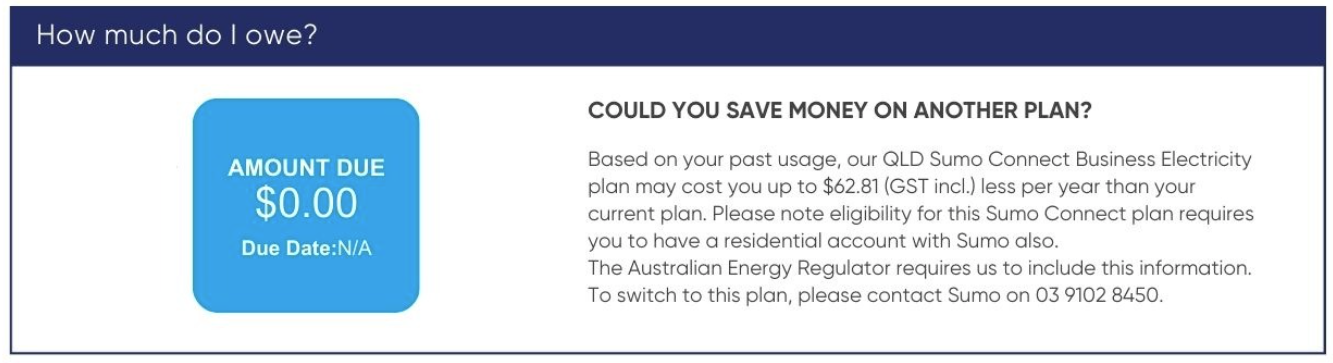
Your Invoice Amount is the total of everything on your bill, including daily supply charges, usage charges, any discounts you've received, and GST. It covers the entire billing period listed at the top of your bill. Don't forget the due date. That's when your payment is due to avoid any late fees.
2. Payment Options
We want paying your bill to be as easy and convenient as possible. That's why we provide a range of payment options to suit everyone, making sure you can manage your energy your way, without any stress.
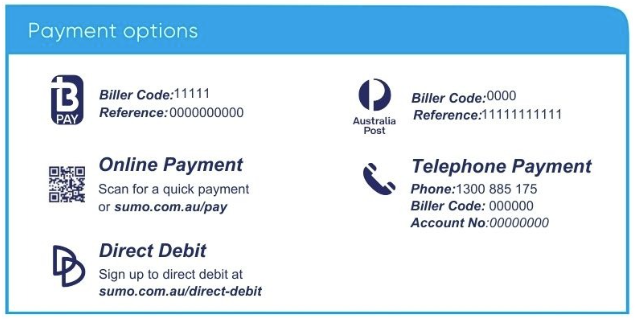
Find the payment option that works best for you here.
Below, you'll find a detailed breakdown of your bill.
| Payment Method | How It Works |
| Online Payment | Pay quickly and easily through the Sumo website or mobile app. Available 24/7. |
| BPAY | Pay through your bank's internet or phone banking. Use the BPAY biller code on your bill. |
| Telephone Payment | Call and pay using your credit or debit card. Simple and fast. |
| Australia Post | Pay in person at your local post office. Bring your bill for the barcode. |
| Direct Debit | Set up automatic payments from your bank account so you never miss a due date. |
| Centrepay | For eligible Centrelink customers, payments are deducted directly from your benefits. Learn more here |
Quick Tip
Setting up Direct Debit is a great way to make sure you never miss a payment. You stay in control and avoid any potential late payment issues. You can set this up easily through your online account.
3. Usage and Exports. How Much Energy Did You Use?
Your bill includes a usage chart that shows your electricity consumption over the past year. This helps you spot patterns, like if your usage spikes in summer due to air conditioning or drops when you're away.
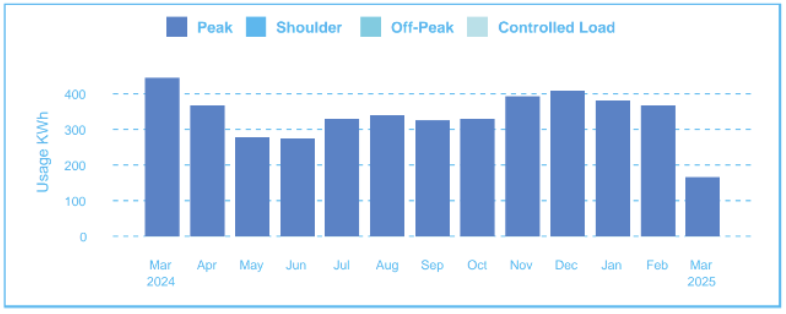
If you're on a Time of Use (TOU) tariff, the chart will break your usage into time bands:
| Time Period | When It Applies | Rate |
| Peak | Weekdays mornings and evenings when demand is highest. | Higher rate |
| Shoulder | Mid-range times, typically late morning to early afternoon on weekdays. | Mid-rate |
| Off-Peak | Overnight hours and weekends when demand is lowest. | Lower rate |
| Controlled Load | A separate circuit for high-use appliances (like hot water systems) that runs during off-peak hours only. | Lowest rate |
Knowing your meter type is also important because it determines how your electricity usage is measured and billed. Your meter affects whether your bill is based on actual usage or estimates, and whether you can take advantage of Time of Use pricing or other advanced tariffs.
Understanding Your Meter Type
How your usage is measured depends on your meter type:
- Basic (Accumulation) Meter: Records total consumption only. Your retailer or network distributor will typically read this meter every 90 days, and your bill may be estimated in between reads.
- Smart Meter (Interval Meter): Records usage in 30-minute intervals and sends data remotely. This means your bill is always based on actual usage — no estimates. It also enables Time of Use pricing, demand tariffs, and detailed usage insights.
4. Understand Your Bill
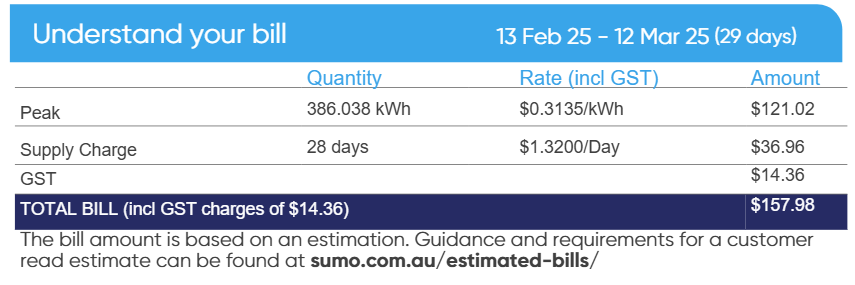
This section of your bill shows a detailed breakdown of your charges for the billing period. It includes your electricity usage during peak times, the daily supply charge for keeping your home connected to the grid, and the GST applied to your total. At the bottom, you'll see the Total Bill, which is the sum of all charges, including GST.
Some bills may be based on estimates if your meter hasn't been read recently, but the breakdown still gives a clear view of how your total amount is calculated and what you're paying for.
Here's a simple example of how the different charges add up:
In the end, understanding your energy bill doesn't have to be confusing. Once you know where to find the key information, you'll have a clear picture of what you're paying for and how to manage it better.
Still have questions about your bill?
Click here to know how your bill is estimated
Click here to see detail on how to read electricity bill in Vic
Click here to see detail on how to read electricity bill in NSW & QLD
Part 2: Understanding your Gas Bill
Just like your electricity bill, your gas bill can look confusing at first glance. But once you know what each section means, it's easy to follow. Let's break it down step by step.
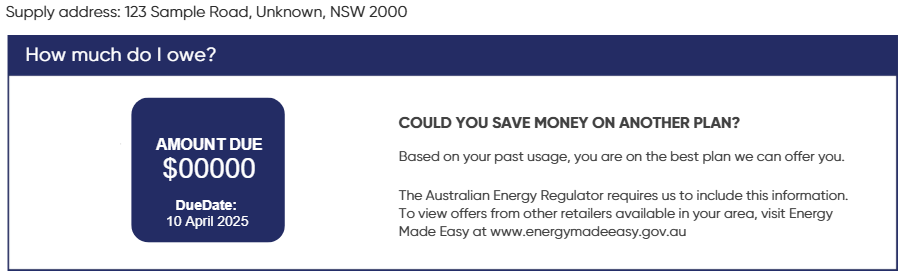
1. How Much Do I Owe?
Just like your electricity bill, the first thing you'll see when you open your gas bill is the total Amount Due and the due date. This is the full amount you need to pay for the billing period shown on your bill.
2. Payment Options:
Good news, paying your gas bill works the same way as your electricity bill. Here's a quick rundown of all the ways you can pay
| Payment Method | How It Works |
| Online Payment | Pay quickly and easily through the Sumo website or mobile app. Available 24/7. |
| BPAY | Pay through your bank's internet or phone banking. Use the BPAY biller code on your bill. |
| Telephone Payment | Call and pay using your credit or debit card. Simple and fast. |
| Australia Post | Pay in person at your local post office. Bring your bill for the barcode. |
| Direct Debit | Set up automatic payments from your bank account so you never miss a due date. |
| Centrepay | For eligible Centrelink customers, payments are deducted directly from your benefits. Learn more here |
Quick tip: Direct Debit is the easiest way to stay on top of your gas bill. Set it up once and it takes care of itself. Visit sumo.com.au/direct-debit to get started.
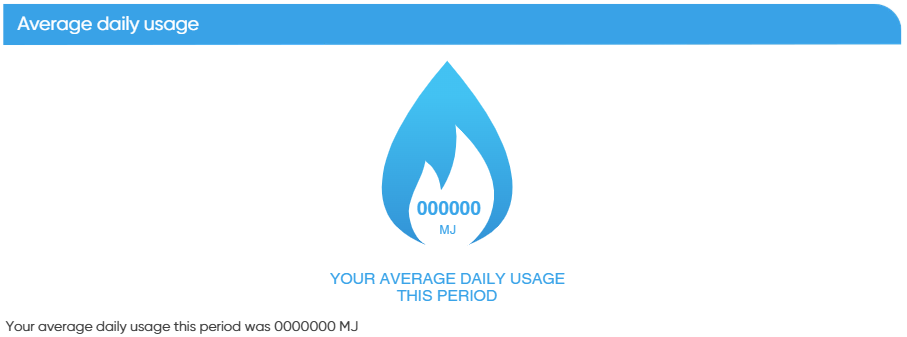
3. Average Daily Usage
This section shows your average daily gas consumption for the billing period. Gas usage is measured in Megajoules (MJ).
What is a Megajoule (MJ)?
This is the standard unit for measuring gas energy in Australia. The more you use appliances like your heater, hot water system, stove, or oven, the more MJ you'll use each day.
Tracking your average daily usage is a great way to notice changes in your consumption. For example, if your usage jumps significantly in winter, it's likely due to increased heating.
Quick Tip: Comparing your average daily usage across different billing periods is one of the best ways to understand your energy habits and spot opportunities to save.
4. Understand Your Bill
This section breaks down exactly how your gas bill is calculated, including every charge, the rate applied, and your total for the billing period. The main difference with gas is how your usage is measured and charged.
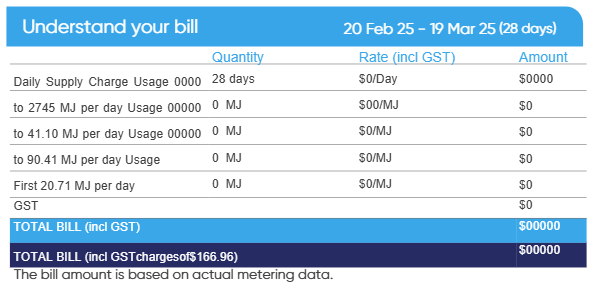
Your gas charges are split into two parts:
- Supply Charge: A fixed daily charge to keep gas connected to your home.
- Usage Charge: Based on the actual amount of gas you used during the billing period, measured in Megajoules (MJ).
Gas rates can change between summer and winter, and your usage is billed in blocks. Once you hit the threshold of one block, a different rate kicks in for the next one.
Quick Tip: The block structure means heavier gas users pay a lower rate per MJ on their higher usage, but the total bill is still higher the more you use. If your usage is consistently high, it may be worth looking at energy-efficient appliances.
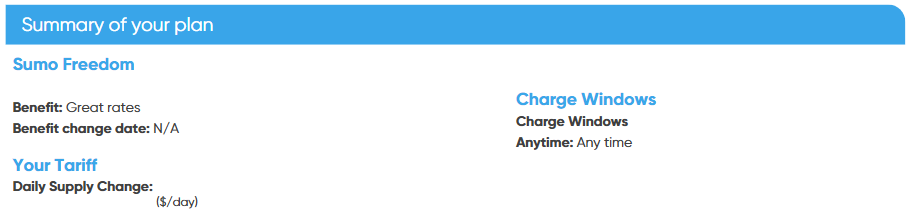
5. Summary of Your Plan
This section gives you a quick snapshot of the plan you're currently on, so you always know what you're signed up to.
If you'd like to review your plan or explore other options, you can log in to your account at sumo.com.au or give our team a call. We're always happy to help you find the right fit.
Still have questions about your gas bill?
Click here to see detail on how to read gas bill in Vic
Click here to see detail on how to read gas bill in NSW
New to Sumo?
Leave your postal code below to check how much you could save with our energy plan in your area.
No Comments Yet